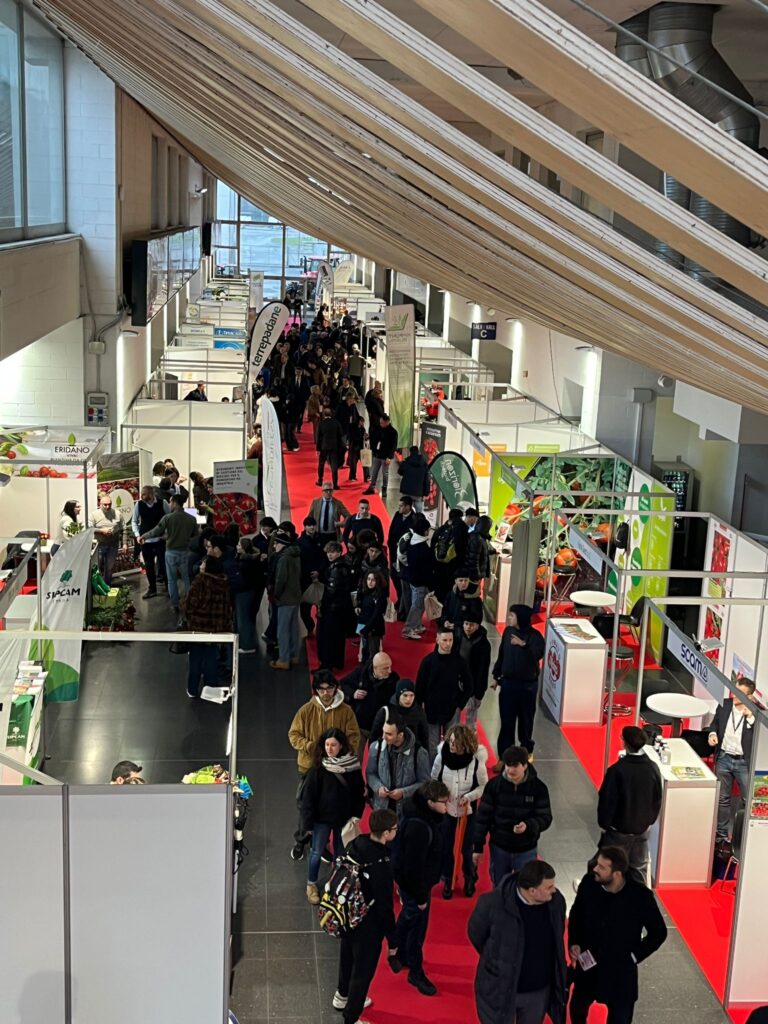


An extremely positive outcome for the 2026 edition of Tomato World, with the exhibition once again confirming its role as the premier strategic event for the Italian industrial tomato supply chain.
“We increased the exhibition area by 30%” commented Giuseppe Cavalli, Piacenza Expo’s President, “a clear signof growing confidence from leading companies in the sector; along with a 25% rise in visitor attendance. In times when markets suffer a significant instability, Piacenza Expo has once again provided the sector with a qualified platform for dialogue with institutions and the political world. The participation of prominent institutional representatives confirmed the relevance of this format in shaping a vision of the immediate future.”
The second and final day of Tomato World opened with the conference “Tomatoes between innovation and strategy: changing and growing in an evolving world”. Coordinated by Professor Paolo Sckokai of the Piacenza’s Università Cattolica del Sacro Cuore, the panel featured contributions from the President of Federchimica, Paolo Tassani; the Vice President of OI Pomodoro da industria Nord Italia, Alessandro Piva; the Director of Consorzio Terrepadane, Dante Pattini; and the Director of the Plant Health Consortia of Parma and Piacenza, Ruggero Colla. The conclusions were delivered by Minister Tommaso Foti.
“From the €3.6 billion allocated by the Conte and Draghi governments under the National Recovery and Resilience Plan (PNRR),” Minister Foti stated, “the Meloni government has increased agricultural investments to nearly €9 billion, strongly supporting agrisolar parks, agri-food logistics, innovation, mechanization, irrigation infrastructure, and supply chain contracts. To safeguard the industrial tomato sector, in which Italy represents a global excellence, we brought to the attention of Raffaele Fitto, Vice President of the European Commission, the issue of market competitors with significantly lower quality and sustainability standards than those applied in Italy, which create unfair competition. We have therefore called for stricter border controls and the application of a principle of reciprocity, particularly regarding health standards.”
High-level conferences addressed the various components of the supply chain, while space was also dedicated to younger generations through workshops organized by the Università Cattolica del Sacro Cuore, ART-ER, LEAP, and Laboratorio Aperto di Piacenza, with the participation of numerous students from the local Agricultural Institute.
“Among the positive highlights,” added the Director of Piacenza Expo, Sergio Copelli, “was the excellent engagement with younger generations through the Tomato World – Next Generation initiative, which allowed many students to gain closer insight into this agri-food sector. The next edition will aim to further strengthen dialogue between agriculture and industry, consolidating a sector that requires deep synergies to meet the challenges of competitiveness in international markets. Fundamental to the success of Tomato World was the work carried out by the Technical Committee and the collaboration of interprofessional organizations, producer groups, and agricultural trade associations.”
The event concluded with the “Tomato World 2026” Award in memory of Luigi Montali, a farmer from Parma who held representative roles in Ainpo and Coldiretti. He was commemorated by the Regional President of Coldiretti, Luca Cotti, and by the President of Ainpo, Filippo Arata. The award was received by his children, in the presence of the Montali family.